
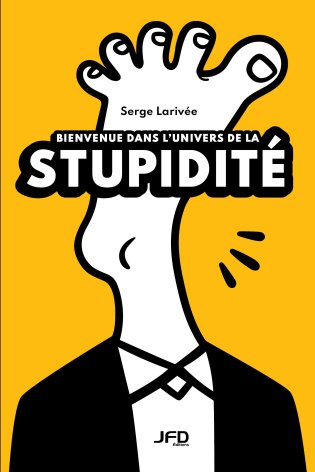
The World of Stupidity, Accessible to Everyone
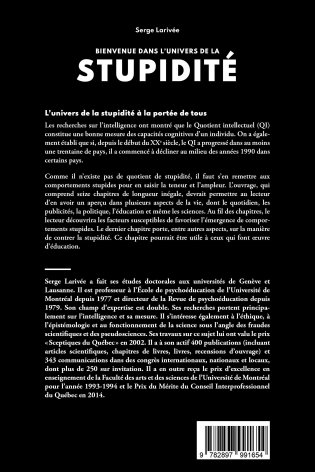
Research on intelligence has shown that the Intelligence Quotient (IQ) is a good measure of an individual’s cognitive abilities. It has also been established that while IQ has risen in at least thirty countries since the early 20th century, it began to decline in some countries in the mid-1990s.
Since there is no such thing as a “stupidity quotient,” we must rely on examples of stupid behavior to grasp its nature and scope. The book, which comprises sixteen chapters of varying lengths, should provide readers with insight into various aspects of life, including daily life, advertising, politics, education, and even science. Throughout the chapters, the reader will discover the factors that may contribute to the emergence of stupid behavior. The final chapter focuses, among other things, on how to counter stupidity. This chapter could be useful to those involved in education.
Serge Larivée completed his doctoral studies at the Universities of Geneva and Lausanne. He has been a professor at the School of Psychoeducation at the University of Montreal since 1977 and editor-in-chief of the Revue de psychoéducation since 1979. His field of expertise is twofold. His research focuses primarily on intelligence and its measurement. He is also interested in ethics, epistemology, and the functioning of science, particularly as it relates to scientific fraud and pseudoscience. His work on this subject earned him the «Sceptiques du Québec» award in 2002. He has authored 400 publications (including scientific articles, book chapters, books, and book reviews) and presented 343 papers at international, national, and local conferences, more than 250 of which were by invitation. He also received the Award for Excellence in Teaching from the Faculty of Arts and Sciences at the University of Montreal for the 1993–1994 academic year and the Award of Merit from the Quebec Interprofessional Council in 2014.