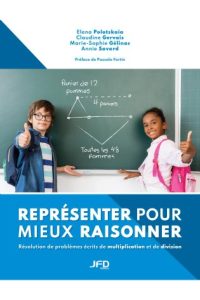
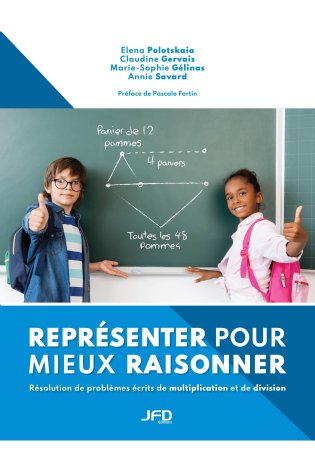
This second book in the Representation for better reasoning is dedicated to solving problems with multiplicative structures. How can these structures be tackled in the classroom? How can we help students develop their multiplicative thinking? Which representations have the potential to support young students' reasoning in a variety of mathematical contexts? How can representations be integrated into the process of solving a written problem? If these questions are on your mind, this book is for you.
Like the first book, this one is the fruit of several years' collaboration between researchers, teachers, educational consultants and remedial educators. It contains 34 classroom-validated learning activities, plus 56 additional problems and tasks. The Web companion, which you can access using the QR code, presents material ready for use in the classroom.
Annie Savard holds a bachelor's degree in preschool and elementary education, a master's degree in science didactics and a doctorate in mathematics didactics. She is an Associate Professor in the Faculty of Education at McGill University. With some fifteen years' experience in primary school teaching, she is also an international educational consultant. In 2019, she was awarded the title of Honorary Professor by Romania's Universitatea Ovidius din Constanta. In addition to the development of mathematical thinking, her research interests concern the teaching and learning of mathematics in primary and secondary schools from a citizen's point of view. Her research program focuses in particular on financial numeracy.
Claudine Gervais holds a bachelor's degree in preschool and elementary education. She taught all levels of primary school for 15 years before becoming an elementary school math consultant in 2007, at the Centre de services scolaires des Grandes-Seigneuries. Aware of teachers' need for tools to support students in the analysis of written problems, and given the success of the balanced approach to problems with additive structure, it was without hesitation that she pursued her collaboration with researchers Savard and Polotskaia to develop, test and publish these new activities supporting the development of students' multiplicative thinking.
Elena Polotskaia holds a bachelor's degree in secondary mathematics education, which she complemented with a master's degree and doctorate in mathematics didactics. She has taught mathematics at secondary level and worked as a remedial teacher, consulting with students in difficulty at all levels of primary and secondary education. She is currently a professor at the Université du Québec en Outaouais, a trainer of future teachers and a researcher in mathematics didactics. She is interested in the development of mathematical thinking in children and the related teaching difficulties.
Marie-Sophie Gélinas holds a bachelor's degree in preschool and elementary education. She taught at primary level before becoming a mathematics consultant at the Centre de services scolaires de la Vallée-des-Tisserands, then at the Centre de services scolaires des Grandes-Seigneuries. Having frequently observed in her practice the difficulties elementary school students have in analyzing mathematical problems, she became familiar with the balanced approach to additive structures developed earlier, and then joined the research project to develop activities for multiplicative structures.