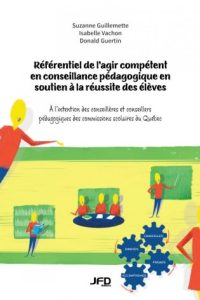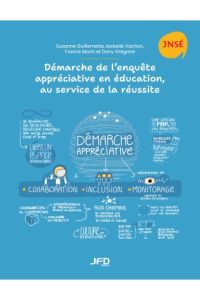
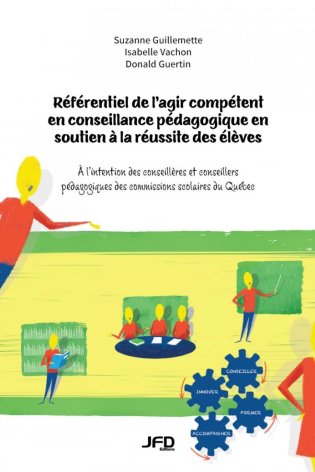
Research conducted from 2015 to 2018 identified four emblematic situations of competent action in educational counseling, which manifests itself through the mobilization, the combination or adaptation of a range of resources in a professional context to implement actions organized into a system. Competent practice develops in action and through action. Advising, training, supporting, and innovating are the four pillars upon which the professional interventions of educational advisors in Quebec’s school boards are based. What characterizes competent practice is an advisor’s ability to step back in order to maintain a sense of detachment from the action.
Donald Guertin was an educational advisor. He also worked as an education specialist at the Ministry of Education, Recreation, and Sports. Retired for 12 years, he now works as a consultant. As part of his graduate research, he developed a support approach to professional development that encourages people to adapt their perceptions in order to act differently: «Think differently, act differently.».
Isabelle Vachon is a member of the Accreditation Committee for Teacher Training. A pedagogical consultant from 2003 to 2020, she worked as a resource person for special needs students at the Service régional de soutien et d'expertise du grand Montréal-Montérégie. From 2014 to 2018, she was president of the Association des Conseillères et des Conseillers Pédagogiques du Québec (ACCPQ). She is a lecturer in the DESS de 2e cycle en conseillance pédagogique program at Université de Sherbrooke.
Suzanne Guillemette is an Associate Professor in the Department of Education and Training Management at the Université de Sherbrooke. She is in charge of the Doctorat professionnel en éducation program and co-director of the educational consulting programs. Using an action-research approach, she combines a collective coaching model designed to support the analysis of practice and reflexivity in management and coaching, in order to support school staff and, consequently, the educational and academic success of their students.