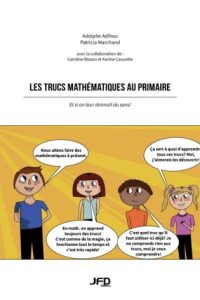
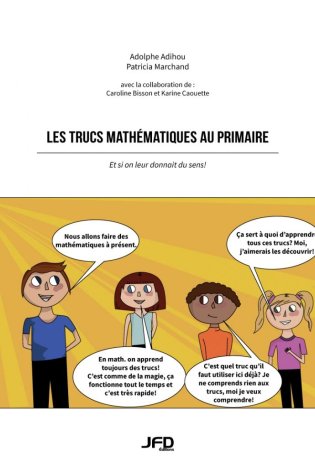
Mathematical concepts (MC) are symbolic or synthetic representations used in the classroom that can create difficulties in teaching and learning if they are used in a «mechanical» way, without understanding. We are referring, among other things, to learning them by heart without understanding or grasping the underlying mathematical processes. While it is in the very nature of mathematics to seek out these concepts to solve problems, classroom practice provides a conducive environment for generating MTs. They will always be present in schools as part of mathematics teaching and learning activities. They cannot be excluded from situations involving the teaching and learning of mathematics. Nor should they be treated as formulas to be applied simply to circumvent difficulties or the learning of mathematical concepts. It is necessary to view them as instructional tools that facilitate the understanding and construction of concepts (Vergnaud, 1991). This necessity has led us to work on TM with teachers and to design activities through a collaborative approach involving teachers and special education teachers.
Our interest in digital tools has led us, in our work, to examine some of the challenges associated with their use in the classroom, asking ourselves when and why these tools should be used with elementary and secondary school students, and to propose types of activities that can be carried out in the context of teaching, instruction, and learning. Our reflections and our mathematical and pedagogical analyses have allowed us to assess their relevance and identify the advantages and disadvantages of using these TM, as well as their limitations and scope in the teaching of mathematics in elementary and secondary school (Adihou, Bisson, Caouette, Marchand, and Archambault, 2015; Adihou, Marchand, Bisson, Caouette, and Archambault, 2014; Adihou and Marchand, 2014; 2010).
The book presents activities and suggests how to carry them out. It provides an explanation of the teaching method to which each activity refers, as well as the type of activity. It also includes testimonials from teachers and special education specialists who participated in designing and testing these activities in the classroom.
Adolphe Adihou is a full professor of mathematics didactics at the Université de Sherbrooke. His doctoral studies focused on equation-based problem solving. His current research focuses on mathematical tricks, teaching and learning difficulties, and the development of algebraic thinking. Involved in initial and continuing training, he designs teaching resources in a collaborative approach and studies their impact on teaching practices.
Patricia Marchand has been an associate professor at the Université de Sherbrooke since 2007. She is responsible for the geometry didactics course in the Baccalauréat en enseignement en adaptation scolaire et sociale program, and has previously taught this course in other Quebec universities and educational training programs. Her doctoral studies focused on a central element of geometry: the development of spatial sense. Her thesis brought together the sports practices that enable this development and those carried out in junior high school mathematics classes. Since then, her research has led her to analyze and propose ways of enriching the teaching of spatial sense and, more generally, of PSGM at primary level, for students in difficulty or in difficult teaching contexts (e.g.: underprivileged environments and multi-level classes).