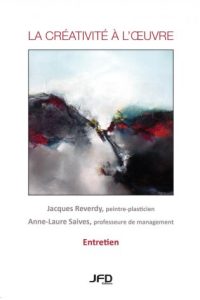
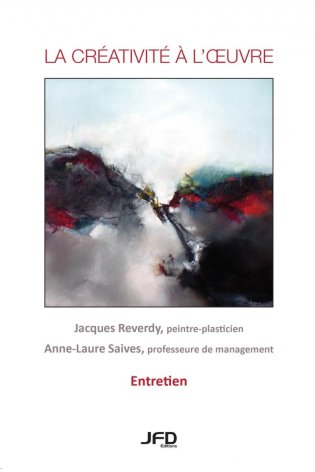
In this long interview with painter and visual artist Jacques Reverdy, we discuss the cultural influences and encounters that shape a creator's trajectory, the imperious demands of creative activity, the intimacy of the painter at work and the meticulous elaboration of the work. It is also a question of rigor and paradoxical approach, of chance and necessity: it is the «doing» that reveals to the painter what he is looking for.
We discover that creativity, in the sense here of the ability to create, involves an existential tension, an act of expression and transformation, a work of research and execution in the vertigo of failures and successes of the creative flow, the implementation of divergent thinking, the surprise of the unexpected and the unifying character of a craft practice that is both physical and psychic. J.R. explains how his research is the result of a complex alchemy between a university education, a teaching career in the arts and a relationship with the world through current affairs, music, travel and family life.
This text invites us to draw on a reflexive account to understand creative activity at a time when the management of ideas is raising questions. Creativity, in fact, is tending to become the founding and salutary foundation of the evolution of human societies: people, social classes, organizations, companies, industries, cities and societies are said to be creative. The urgency of economic and territorial development has made creativity an indispensable tool. But what are we talking about? What is creativity, so caught up in managerial fashion?
Creativity must not be reduced to a mere instrument for producing ideas. If, on the contrary, we consider management from a human and locally-rooted perspective, then we need to question the nature and place of creativity at the very foundation of human action. How can a reflection on a «living» creative approach lead to the emergence of lessons, tools and practices that can help us in the Management Sciences to think about management differently? It was with this question in mind that we set out to examine the research-creation practice of an artist who calls himself first and foremost a worker-craftsman.
management professor