Click here to view the promotional flyer.
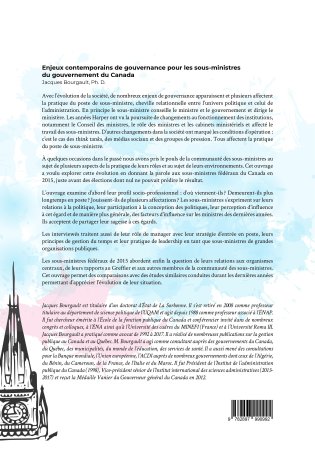
As society evolves, numerous governance challenges have emerged, many of which affect the role of the deputy minister—the linchpin linking the political and administrative spheres. In principle, the deputy minister advises the minister and the government and leads the department. The Harper years saw ongoing changes to the functioning of institutions—notably the Cabinet, the role of ministers, and ministerial staff—which affected the work of deputy ministers. Other societal changes have shaped the operating environment, such as think tanks, social media, and advocacy groups. All of these influence the role of the deputy minister.
On a few occasions in the past, we have gauged the views of the community of deputy ministers on various aspects of how they carry out their roles and on their working environments. This book sought to explore these developments by giving a voice to Canada’s federal deputy ministers in 2015, just before an election whose outcome no one could predict.
The book first examines their socio-professional profiles: Where do they come from? Do they stay in their positions longer? Do they hold multiple posts? Deputy ministers discuss their relationship to politics, their involvement in policy development, their perception of their influence in this regard, and, more generally, the factors that have influenced ministers in recent years. They are willing to share their insights on these matters.
The interviewees also discuss their roles as managers, including their strategies for settling into their new positions, their time-management principles, and their leadership practices as deputy ministers of major public organizations.
The 2015 federal deputy ministers finally address the issue of their relationships with central agencies, as well as their interactions with the Clerk and other members of the deputy minister community. This book allows for comparisons with similar studies conducted in recent years, making it possible to assess how their situation has evolved.
Jacques Bourgault holds a doctorate from La Sorbonne. He retired in 2008 as a full professor in the Department of Political Science at UQAM, and has been an associate professor at ÉNAP since 1988. He was an emeritus researcher at the Canada School of Public Service and a guest lecturer at numerous conferences and symposia, including ÉNA, the Université des cadres du MINEFI (France) and Université Roma III. Jacques Bourgault practiced as a lawyer from 1992 to 2017. He has published extensively on public management in Canada and Quebec. Mr. Bourgault has acted as a consultant to the governments of Canada, Quebec, municipalities, education and health services. He has also consulted for the World Bank, the European Union and CIDA with numerous governments, including those of Algeria, Benin, Cameroon, France, Italy and Morocco. He was President of the Institute of Public Administration of Canada (1998), Senior Vice-President of the International Institute of Administrative Sciences (2013-2017) and received the Vanier Medal from the Governor General of Canada in 2012.