In Mesopotamia and Egypt, the first societies in which traces of writing can be found, fractions appeared as part of the social practices of measuring, sharing and distributing material goods.
Chevallard (1989) emphasizes that: «the problem is not simply the empirical sharing of goods, as might be achieved by an individual, or a restricted group of individuals - whose action is primary and self-sufficient - but a higher managerial authority that must decide on the terms of sharing, the procedures to be followed, even before the action is carried out».
For the Greeks, the notion of fraction appeared in the context of ratios and proportions, and was not associated with a type of number comparable to today's rational numbers.
The development of fractions continued in Arab-Islamic civilization and spread to medieval Europe through trade. Towards the end of the Middle Ages, the theory of ratios and proportions evolved towards an arithmetization of these concepts, which encouraged calculations and the development of fraction arithmetic.
The theory of proportions continued to play a fundamental role in the development of Viète's algebra (in the 17th century), and fractions were linked to division. Towards the end of the 16th century, Stevin succeeded in spreading the use of decimal fractions and decimal numbers, enabling Descartes, a few years later, to base his algebra on the idea of measurement (Kibindigiri, 1995).
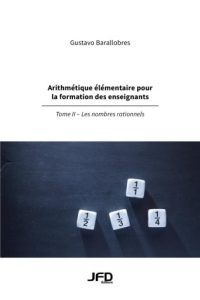
In this text, we present various uses (internal or external to mathematics) of rational numbers, both in their fractional and decimal representations, and their relationship to other mathematical concepts for which this type of number plays a fundamental role.
Gustavo Barallobres is a professor of mathematics didactics in the Department of Specialized Education and Training at the Université du Québec à Montréal and a member of the Groupe d'études sur l'enseignement/apprentissage des mathématiques en adaptation scolaire (GEMAS) at the Université du Québec à Montréal. He is also a researcher at the "Culture et diffusion des savoirs" laboratory, Université Victor Segalen, Bordeaux 2, France.