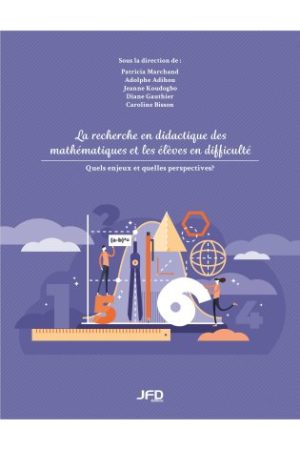
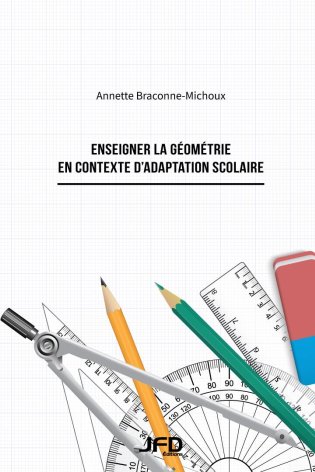
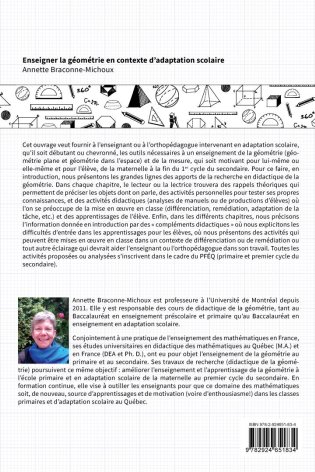
The aim of this book is to provide special needs teachers and remedial educators, whether beginners or experienced, with the tools they need to teach geometry (plane geometry and geometry in space) and measurement in a way that is motivating for both themselves and their students, from kindergarten to the end of Cycle 1 of secondary school. To this end, the introduction outlines the main contributions of research in geometry didactics. In each chapter, the reader will find theoretical reminders to clarify what we're talking about, personal activities to test one's own knowledge, and didactic activities (analyses of textbooks or student productions) where we're concerned with classroom implementation (differentiation, remediation, task adaptation, etc.) and student learning. Finally, in the various chapters, we expand on the information provided in the introduction with "didactic complements", in which we explain the difficulties students face in entering the learning process, present activities that can be implemented in the classroom in a differentiation or remediation context, or any other insight that should help the teacher or remedial therapist in his or her work. All the activities proposed or analyzed are part of the QEP framework (primary and lower secondary).
Annette Braconne-Michoux has been a professor at Université de Montréal since 2011. She is responsible for geometry didactics courses in both the Baccalauréat en enseignement préscolaire et primaire and the Baccalauréat en enseignement en adaptation scolaire.nIn conjunction with her mathematics teaching practice in France, her university studies in mathematics didactics in Quebec (M.A.) and France (DEA and Ph.D.) have focused on geometry teaching at primary and secondary levels. Her research work (didactics of geometry) pursues the same objective: to improve the teaching and learning of geometry in elementary school. In continuing education, she aims to equip teachers so that this area of mathematics is once again a source of learning and motivation (and even enthusiasm) in Quebec primary school classrooms.