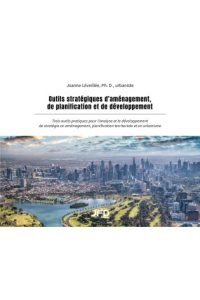
The toolbox of geographers, planners and urban planners is based on a variety of data and databases that have become much more complex over the last thirty years. Although the basic methodology remains the same, the complexity of the information to be inventoried, processed and analyzed requires much more time to understand the phenomena and the natural and human issues at stake. It also requires more time to synthesize information gathered at a point in time that may or may not belong to the recent past, but whose dynamic environment requires systematic adjustment of interventions to avoid the obsolescence of the recently-developed planning proposal.
The content of the information from the various databases is organized more systematically with the P.E.S.T.E.L. strategic tool, since it enables us to identify the problems of a territory. Then, the dynamic F.F.O.M. strategic analysis tool is used to highlight and develop arguments on the various intervention strategies that are, or should be, implemented in this territory. The third strategic tool proposes the integration of an intervention approach based on sustainable development principles, using an urban planning tool: the comprehensive development plan. These strategic planning and development tools are just as effective in the context of a consultancy mandate.
It should be noted that the three strategic planning and development tools can be used alone or in combination with other urban planning tools, such as the Plan particulier d'urbanisme (PPU) and the Plan d'insertion et d'intégration architecturale (PIIA), which are not included in the document.
Dr. Joanne Léveillée has been a member of the Ordre professionnel des urbanistes du Québec (O.U.Q.) and the Canadian Institute of Planners (I.C.U.) since 1993. Her training is multidisciplinary. She holds an undergraduate degree in geography (B.Sc.g.) from the Université de Sherbrooke, a graduate degree (M.Sc.App.A.) and a doctorate (Ph.D.) in planning from the Université de Montréal and another graduate degree (M.Eng.) in international projects and global engineering from the École de technologie supérieure (É.T.S.). She speaks and writes three languages: French, English and Spanish.nFor over thirty years, she has pursued a dual career. First, in private practice with engineering firms, or as a consultant with multidisciplinary teams on national and international projects in transport infrastructure, land use planning and development, the environment and urban planning. She also teaches and researches at the Université de Sherbrooke and the Université du Québec à Montréal. Her main area of research is public transportation. In 2007, the Université de Sherbrooke filed a temporary patent for the development of a tool to aid public transit (bus) planning, mainly using geomatic tools. Ms. Léveillée has also worked in multidisciplinary public health research teams at the Groupe d'études et de recherche en analyse de la décision (G.É.R.A.D. an inter-university research center composed of Université de Montréal, École Polytechnique, UQAM, HEC Montréal and McGill University).nIn 2018, the Conseil interprofessionnel du Québec (C.I.Q.), an exchange forum for Quebec's professional orders, through the Ordre des urbanistes du Québec, recognized Ms. Léveillée's professional contribution to the Order's urban planning and university program evaluation committees, and for her pan-Canadian influence on the Professional Standard Board, by awarding her the Mérite du C.I.Q.