
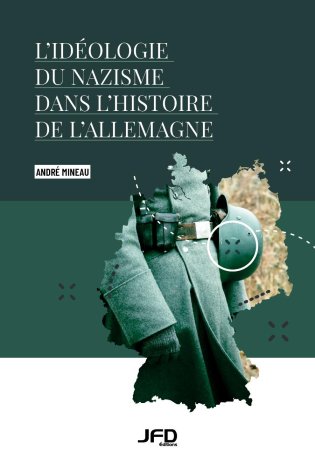
From the outset, we must firmly condemn all forms of racism, including anti-Semitism, Nazism and other comparable ideologies. Racism is certainly one of the ugliest products of the human mind, and in contemporary times it has generated and sustained many oppressive political systems. As for the Nazis, who relied on a modernized, racialized version of anti-Semitism, they conceived and committed horrific crimes against humanity that should never be forgotten.
That said, historians work to reconstruct the past, which requires efforts to describe and explain the workings of the human mind in specific social and cultural contexts. In this respect, it should be noted that the Nazis emerged in the context of the particular environment that prevailed at the end of the First World War, and which was clearly to have a profound influence on radical right-wing ideas. Nazi ideology emerged as a synthesis that accentuated the strong tendencies of a cultural and moral drift. On the one hand, it presented itself as a modernized form of political thought, plugged into the scientific paradigm and the social translation of biological knowledge. On the other, it conceived Europe as a field of application for European colonialism.
Nazi ideology found its practical expression in an ethic based entirely on an anthropology of difference, erecting impassable barriers between individuals and peoples, and on a biology that could justify everything. At the same time, it underpinned a frenetic activity aimed at overcoming 1918 and replaying the Great War, so that it would finally come to a happy conclusion. For the Nazis, this frenzy was linked to the urgent need to expand Germany's living space and settle the Jewish question.
André Mineau is Professor of History and Philosophy at the Université du Québec à Rimouski. His research and publications focus on European totalitarian ideologies. His publications include Operation Barbarossa: Ideology and Ethics Against Human Dignity (Amsterdam and NewYork, Rodopi, 2004), and SS Thinking and the Holocaust (Rodopi, 2012).