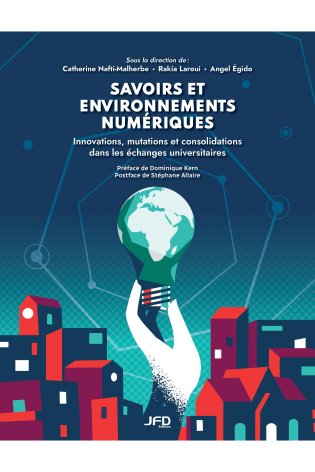
Foreword by Dominique Kern
Afterword by Stéphane Allaire
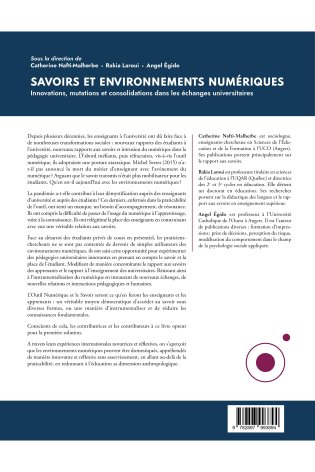
Over the last few decades, university teachers have had to cope with a number of social transformations: new relationships between students and universities, new relationships with knowledge, and the intrusion of digital technology into university teaching methods. Initially wary of, then resistant to, digital tools, they adopted an ataraxic posture. Didn't Michel Serres (2015) predict the death of the teaching profession with the advent of digital technology? He argued that the knowledge transmitted was no longer mobilizing for students. What is the situation today with digital environments?
Has the pandemic helped demystify them for university teachers and students alike? The latter, locked into the practicality of the tool, felt a lack, a need for support and resonance. They understood the difficulty of moving from digital use to learning, or even knowledge. They relegitimized the role of teachers by building a genuine relationship with them.
Faced with the dismay of students deprived of face-to-face classes, practitioner-researchers have not been content to simply become users of digital environments, but have seized this opportunity to experiment with innovative university pedagogies that take into account the knowledge and place of the student. The result is a concomitant change in learners' relationship to knowledge and academics' relationship to teaching. Resisting the instrumentalization of digital technology by establishing new exchanges, new relationships and new pedagogical and human interactions.
Digital tools and knowledge will be what teachers and learners make of them: a truly democratic means of accessing knowledge in its various forms, or a way of instrumentalizing and reducing fundamental knowledge.
Aware of this, the contributors to this book have opted for the first solution.
Through their innovative and reflexive international experiences, we see that digital environments can be domesticated, apprehended in an innovative and reflexive way without enslavement, going beyond practicality and restoring the anthropological dimension of education.
Angel Égido is a professor at the Université Catholique de l'Ouest in Angers. He is the author of various publications on impression formation, decision-making, risk perception and behavior modeling in the field of applied social psychology.
Catherine Nafti-Malherbe is a sociologist and teacher-researcher in Education and Training at UCO (Angers). Her publications focus mainly on the relationship with knowledge.
Rakia Laroui is a full professor of education at UQAR (Quebec) and director of the graduate program in education. She holds a doctorate in education. Her research focuses on language didactics and the relationship to knowledge in higher education.