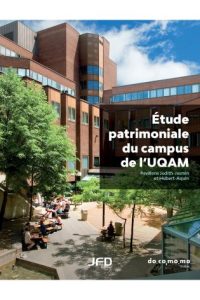
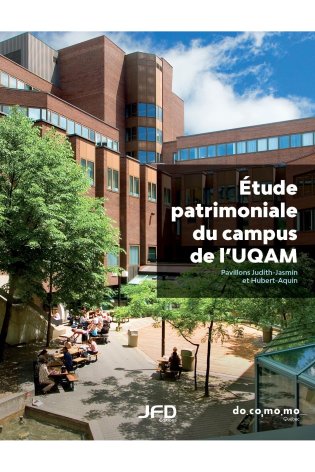
At first glance, for users who have been familiar with the site for many years, the original UQAM campus has changed little over time. The brown-brick ensemble, which incorporates the bell tower and south transept of the former Saint-Jacques church and surrounds the Notre-Dame-de-Lourdes chapel, is articulated around two public spaces - one interior, to the north of rue Sainte-Catherine, and the other exterior, to the south - and is irrigated by a pedestrian network that crosses it from the mezzanine of the Berri-UQAM metro station. At the heart of the Judith-Jasmin pavilion is a multi-storey atrium, the agora, while the Hubert-Aquin pavilion surrounds a tree-lined courtyard. But who remembers that the campus was to include retail space? Who can make the connection between UQAM's original mission - a university that was intended to be popular, critical and open to the community - and architecture? Its most obvious particularity is its downtown location, unlike previous campuses in Montreal. What's more, the stratification of the buildings is no stranger to the double, non-faculty structure of the new university. Nevertheless, the architecture's adherence to UQAM's institutional project is no longer clear to many. What's more, while the general ambience remains, the organization and purpose of the spaces have undergone numerous changes. UQAM celebrates its 50th anniversary in 2019. The campus, which dates back to the 1970s, needs to be brought up to date to meet the changing needs of teaching and learning as a result of new information technologies. In addition, as its pavilions are in need of major refurbishment, it is necessary to consider the desirability of retaining the original layout. The aim of this study is to establish the heritage value of the original UQAM campus on the basis of literature and archival research, in order to identify the original institutional project and its urban and architectural translation, to situate them within the movements that, at the turn of the 1960s, were turning society upside down, and to specify the link with the cultural and architectural tradition attached to university campuses.
The editorial team is made up of three members of Docomomo Québec, who are close to the Diplôme d'études supérieures en architecture moderne et patrimoine (DESS) at the École de design de l'UQAM, which aims to raise awareness and appreciation of modern architecture and, by the same token, encourage its preservation. Experienced journalist Marc Doré and museologist Soraya Bassil are graduates of the DESS, while France Vanlaethem, now Professor Emeritus, was its first director.