
Preface by Diane Morin
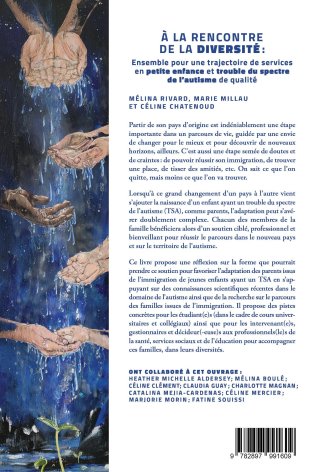
Leaving one's country of origin is undeniably an important step in a person's life, guided by a desire to change for the better and to discover new horizons elsewhere. It's also a step fraught with doubts and fears: about whether you'll be able to successfully immigrate, find a place, make friends and so on. We know what we're leaving behind, but less about what we'll find.
When this major change from one country to another is compounded by the birth of a child with an Autism Spectrum Disorder (ASD), as parents, the adjustment can be doubly complex. Each member of the family will benefit from targeted, professional and benevolent support to help them successfully navigate the new country and the territory of autism.
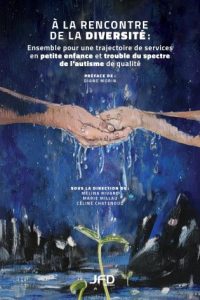
This book proposes a reflection on the form that this support could take to promote the adaptation of immigrant parents of young children with ASD, based on recent scientific knowledge in the field of autism as well as research on the journey of immigrant families. It proposes concrete approaches for students (in university and college courses), as well as for health, social services and education professionals, managers and decision-makers, to support these families, in all their diversity.
Contributors to this book : Heather Michelle Aldersey; Mélina Boulé ; Céline Clément; Claudia Guay; Charlotte Magnan; Catalina Mejia-Cardenas; Céline Mercier; Marjorie Morin; Fatine Souissi
Céline Chatenoud recently took up a position in early childhood special education at the University of Geneva, after 10 years as a professor in the Department of Specialized Education and Training at the Université du Québec à Montréal (UQÀM). Through research and teaching, she aims to contribute to a better understanding of the support needed to enable children with disabilities to express their full potential and grow up self-determined and valued in their diversity. At the heart of her research interests are the mechanisms of exclusion that hinder their full participation in preschool and school settings, and the development of their parents' power to act. A regular member of the Institut universitaire en DI-TSA de la Mauricie Centre du Québec and the Laboratoire Accrochage Scolaire et Alliances Éducatives (lasalé), as well as an associate researcher at the Laboratoire International sur l'Inclusion Scolaire (Lisis), she contributes to a number of studies relating to the development of inclusive educational communities and interprofessional collaboration.
Marie Millau holds a doctorate in psychology from UQAM and a master's degree in clinical psychology and psychopathology from Université Paris 8. She worked for several years in Paris and Cameroon with children with autism spectrum disorders and their families. She began her academic career as a doctoral student in the EPAULARD laboratory directed by Mélina Rivard, and was also an assistant then lecturer at UQAM in the psychology department. Following her doctorate, she worked in a pilot ASD diagnostic clinic, providing diagnostic assessment and family support. Throughout her career, she has been committed to developing her knowledge and skills in both research and clinical work with these children and their families, with a particular focus on issues related to cultural diversity. Her doctoral thesis and subsequent research activities focused on the experiences of immigrant parents living with a child with ASD. Currently, Marie Millau works as part of the team at the CHU Sainte-Justine's Marie-Enfant rehabilitation center. Alongside her clinical practice, she continues to enrich her research interests in relation to the experiences of families from diverse backgrounds in several projects at the EPAULARD laboratory.
Mélina Rivard has been a psychologist and professor-researcher in the Department of Psychology at UQAM since 2012. She previously worked as an institutional researcher in settings specializing in autism spectrum disorder (ASD) and intellectual disability (ID), and has been working clinically with young children with developmental disabilities and their parents for nearly 20 years. The needs expressed by families and caregivers motivated her to develop a research program to improve the trajectory of services received by young families, from the first suspicion of a disorder, through specialized early intervention services, to school entry. The program capitalizes on the development of positive supports and capacity-building in practice settings, and focuses on three research axes: 1. Intervening early and effectively: acting on children's development... 2. Supporting the psychological health of children, their families and caregivers. 3: Promoting parents' knowledge and empowerment. Active in several research environments, she is a regular researcher at the Institut universitaire en déficience intellectuelle et en trouble du spectre de l'autisme, at the Institut universitaire en santé mentale de Montréal, co-titular of the Chaire de déficience intellectuelle et troubles de comportement at UQAM and director of the Laboratoire d'Étude des Problématiques comportementales en Autisme et Les Autres Retards du Développement (Épaulard).