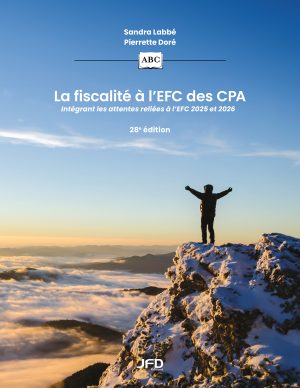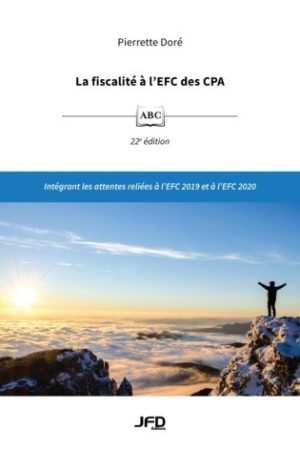
Now in its 26th edition, this volume continues to fulfill its goal of helping CPA candidates by providing a summary of the tax concepts they need to master in order to prepare effectively for the EFC. The concise and straightforward text will allow students to quickly identify the topics they already understand and those that require further study. To this end, the spacious layout and wide margins allow students to supplement the information provided, helping them make the book’s content their own so that it becomes «their» personal summary and «their» working tool.
Since its publication, at a time when DESS programs in accounting were being established in Quebec, this volume has introduced the innovative concept of presenting information according to the proficiency levels associated with each of the tax concepts required for the professional exam. Thus, at a glance, students can see the specific expectations outlined in the new competency framework applicable to the 2023 and 2024 EFC. References to Levels A, B, or C therefore provide valuable information both for students who need to master the material at the level of the common modules in the CPA Competency Framework and for those aiming to take the Day 2 tax section of the EFC. Even since the introduction of the EFC, references to the level of depth required for the EFU (the Uniform Final Evaluation for Certified Public Accountants) have been retained, as they allow students and instructors to draw an interesting parallel between the expectations set forth in both exams.
In addition, the volume provides a review of numerous questions from previous CFEs and UFEs in which the various topics covered were questioned. A quick glance at these lists of questions enables students to identify the most frequently tested topics, thus indicating the importance of mastering the tax concept in question. Finally, the appendices provide numerous cross-references that will prove most useful to the student.
Pierrette Doré, professor of taxation at the Université du Québec en Abitibi-Témiscamingue (UQAT) for over 30 years and heavily involved in the CA and CPA examination process. A marker for both the UFE and the CFE for 25 years, responsible for the DESS in accounting sciences program at UQAT for more than 18 years, and a member of numerous committees related to the professional training of CAs, then CPAs, at both the Quebec and Canadian levels, Ms. Doré has always been keen to accompany candidates on their training journey towards obtaining their professional designation.
Sandra Labbé, M.Fisc., CPA, CA. Drawing on her experience as a tax specialist with Deloitte, an accounting firm, Ms. Labbé has been involved in student training for the past three years. She is involved in teaching both in the classroom and by distance learning, at both undergraduate and postgraduate levels. Her constant concern to help students on their way to obtaining the CPA designation explains her involvement in the publication of specialized works.