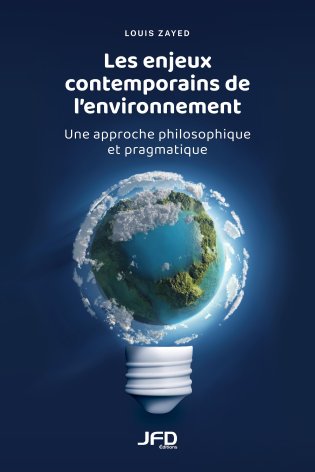
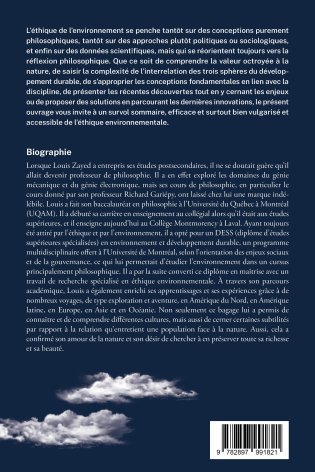
Environmental ethics is sometimes based on purely philosophical conceptions, sometimes on political or sociological approaches, and finally on scientific data, but is always reoriented towards philosophical reflection. Whether it's to understand the value placed on nature, to grasp the complexity of the interrelation between the three spheres of sustainable development, to grasp the fundamental concepts related to the discipline, to present recent discoveries while identifying the issues at stake, or to propose solutions by exploring the latest innovations, this book invites you to a brief, effective and, above all, accessible overview of environmental ethics.
When Louis Zayed began his post-secondary studies, little did he know that he would become a philosophy teacher. He had indeed explored the fields of mechanical and electronic engineering, but his philosophy courses, in particular those taught by his professor Richard Gariépy, left an indelible mark on him. Louis completed his bachelor's degree in philosophy at the Université du Québec à Montréal (UQAM). He began his teaching career at the college level while still a graduate student, and now teaches at Collège Montmorency in Laval. Having always been attracted to ethics and the environment, he opted for a DESS (diplôme d'études supérieures spécialisées) in environment and sustainable development, a multidisciplinary program offered at the Université de Montréal, with a focus on social issues and governance, which enabled him to study the environment in a mainly philosophical context. He subsequently converted this degree into a master's with a research project specializing in environmental ethics. Throughout his academic career, Louis has also enriched his learning and experiences through numerous exploration and adventure trips to North America, Latin America, Europe, Asia and Oceania. Not only did these experiences enable her to get to know and understand different cultures, they also gave her an insight into the subtleties of people's relationship with nature. It also confirmed her love of nature and her desire to preserve all its richness and beauty.